How EMRs Improve Multi-Specialty Clinics’ Operations
EMR for multi-specialty clinics addresses one of healthcare’s most persistent operational problems. Cardiology, orthopedics, neurology, and primary care share the same building, the same administrative staff, and often the same patients. Each department has distinct workflows, documentation requirements, and care protocols. Coordinating all of that is, by design, difficult.
When patient information is kept in different systems, or just on paper, important details can be missed and costs can rise. For example, if a cardiologist orders tests for a patient who has already seen a neurologist, they might not know what has already been ordered, what is still pending, or which medications the patient is taking. This overlap slows down care and increases risk.
EMRs solve this problem by acting as a single, shared system where every department can access and update patient information at the same time. This helps the clinic work as one coordinated team instead of separate, disconnected practices.
Key Takeaways
- EMRs bring all patient records together, so every clinician can see the same up-to-date information.
- When EMRs are set up well, they can save clinicians as much as 75 minutes a day on paperwork. This gives them more time to focus on patient care.
- Automatic alerts and reminders help prevent scheduling problems, missed follow-ups, and medication mistakes.
- When records are shared, it’s easier for different specialists to coordinate care. This reduces gaps, repeated work, and mistakes during handoffs.
- With cloud-based and mobile EMRs, clinicians can access and update records from anywhere, at any time online during patient care.
- Centralized workflows help lower costs by reducing the need for paper storage, manual data entry, and avoidable mistakes.
The Real Cost of Traditional Systems
Paper records often slow things down. Staff spend valuable time filing, finding, and updating paper charts, time that could be spent with patients. Charts can be lost, and handwriting can be hard to read. According to the National Library of Medicine, nearly 50% of all medication errors occur during the prescription process, and illegibility is a significant driver.
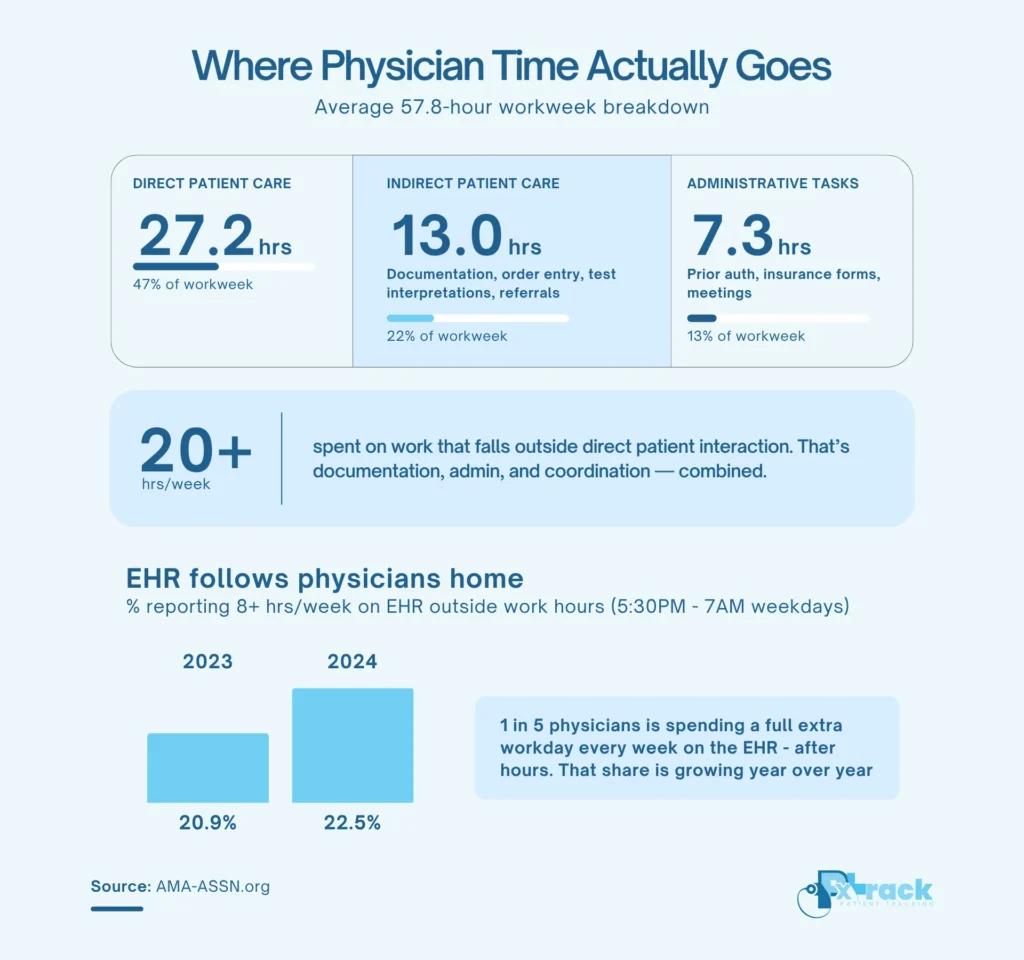
Disconnected electronic tools are a subtler problem. A scheduling tool that doesn’t communicate with the clinical record results in duplicate entries. A billing system that pulls from outdated data leads to claim errors. These aren’t edge cases; they’re the daily friction that adds up to hours of wasted staff time per week.
Source: AMA-ASSN.org.
In clinics with many specialties, coordinating care is even more challenging than in single-specialty practices. There’s less room for mistakes. For example, if a follow-up is missed between an internist and a specialist, it’s harder to notice without a shared system to highlight the gap.
How EMRs Improve Clinic Operations
EMRs bring real, measurable improvements to multi-specialty clinics. The biggest change is centralization, where every department uses the same patient record system. When one doctor orders lab tests, all authorized clinicians can see the results as soon as they’re available.
Scheduling and coordination are much better with EMRs. Alerts can warn about appointment conflicts, show pending referrals, and send automatic follow-up reminders. Studies show that clinics using EMRs can improve efficiency by up to 30%. This helps reduce the daily hassles that often lead to staff burnout.
EMRs can be set up for each specialty’s needs. For example, dermatology can use templates for skin exams, while orthopedics can focus on imaging. All of this information goes into the same patient record. According to Mordor Intelligence, specialty EMR systems are expected to grow at a 6.49% annual rate through 2031. This shows strong demand for these targeted, connected systems.
Cloud-based EMRs add even more value. Clinicians can access records from any approved device, whether they’re moving between exam rooms or working remotely. Real-time updates mean that new information, like vital signs, lab results, and notes, is instantly available everywhere.
Benefits for Physicians and Patients
For doctors, EMRs provide clear, complete information. With real-time records, they can make decisions with all the facts. Alerts warn about drug interactions before prescriptions are written, and allergy histories are easy to see. When a doctor meets a patient for the first time, they don’t have to guess or piece together the patient’s history.
This clear information leads to quicker and safer decisions. Well-implemented EMRs also cut down on paperwork time. A 2025 case study in the Journal of Education and Health Promotion found that EMRs saved clinicians about 75 minutes a day on documentation. That’s more time for patient care, not just typing.
Patients also benefit from better coordination. When their internist, cardiologist, and physical therapist all use the same record, care gaps are closed. Follow-up instructions are not missed, and prescriptions don’t overlap. Moving between specialties in the clinic feels smooth instead of disjointed.
As research on digitized clinic patient trust shows, patients increasingly assess provider competence based on how organized their digital systems appear. When a physician can instantly access test results, review a complete medication history, and reference prior consultations, it signals organizational capability and drives retention.
Administrative staff also see benefits. With billing, prescriptions, reports, and appointments all in one system, there’s less switching between tasks. EMRs help cut costs by removing the need for paper storage, reducing manual data entry, and lowering the number of preventable mistakes.
Why EMRs Are Essential for Multi-Specialty Clinics
The need for EMRs in multi-specialty clinics is backed by real evidence. Data, research, and practical results all support their use. More clinics are adopting EMRs, especially as digital requirements, cloud technology, and AI tools become more common. Ambulatory and multi-specialty clinics are some of the fastest to adopt these systems.
Clinics using centralized EMRs make fewer mistakes, coordinate care better, and work more smoothly. Clinics that still use separate systems or paper records fall behind, especially as they get busier and cases become more complex.
For multi-specialty clinics, an EMR is the foundation for working together and providing efficient care. When departments share information instantly, get alerts before issues arise, and all doctors use the same complete record, the clinic works as one team. Patients get better care, staff have fewer hassles, and the clinic runs smoothly, quickly, and in sync.
Discover how an EMR designed for clinics like yours can make daily operations easier. Take a look at PxTrack EMR today.

Frequently Asked Questions
What is an EMR, and how is it different from an EHR?
An EMR is a digital patient chart used within one practice. An EHR is meant to be shared between different organizations. In reality, people often use these terms to mean the same thing. Multi-specialty clinics usually use an EMR that can work like an EHR within their departments.
How do EMRs support coordination between different specialties?
EMRs let every department see the same patient record right away. If a primary care doctor refers a patient to cardiology, the cardiologist can instantly view the patient’s full history. There’s no need to transfer charts. Alerts, referral tracking, and shared appointment calendars help close any coordination gaps.
How long does it take to implement an EMR in a multi-specialty clinic?
Timelines vary by clinic size and number of specialties. A smaller multi-specialty practice may go live in two to three months. Larger clinics with complex integrations typically plan for six to twelve months. Phased rollouts, starting with one department and expanding, are common for minimizing disruption.
Sources:
How Our EMR Solution Can Help Multi-Clinic Practices Stay Connected, IISLB.com
Cross-Platform EMR Integration with Billing: The Ultimate Solution for Multi-Specialty Practices, Relimeds.com
Maximize EMR Features for Faster, More Efficient Documentation, Thenoteninjas.com