The Cost vs. Benefits Debate:Why EMRs Are a Smart Investment
Electronic medical records do require some upfront spending, but they pay off in the long run. Clinics that use a reliable EMR handle less paperwork, make fewer billing mistakes, and can see more patients with the same staff. While the initial cost is higher, the long-term benefits are greater.
Key Takeaways
- The initial cost includes software, setup, and staff training. With cloud-based systems, these costs are lower than with traditional on-site installations.
- Clinics using electronic medical records report faster claim processing, fewer duplicate tests, and less time spent on manual charting.
- A study of primary care clinics found that, on average, clinics broke even about ten months after adopting an EMR.
- Clinics that go digital see a clear rise in the number of patients each clinician can see. The benefits go beyond just making administrative tasks easier.
Understanding the Initial Investment
Before switching to electronic medical records, every clinic owner asks the same question: What will this cost, and is it worth the investment?
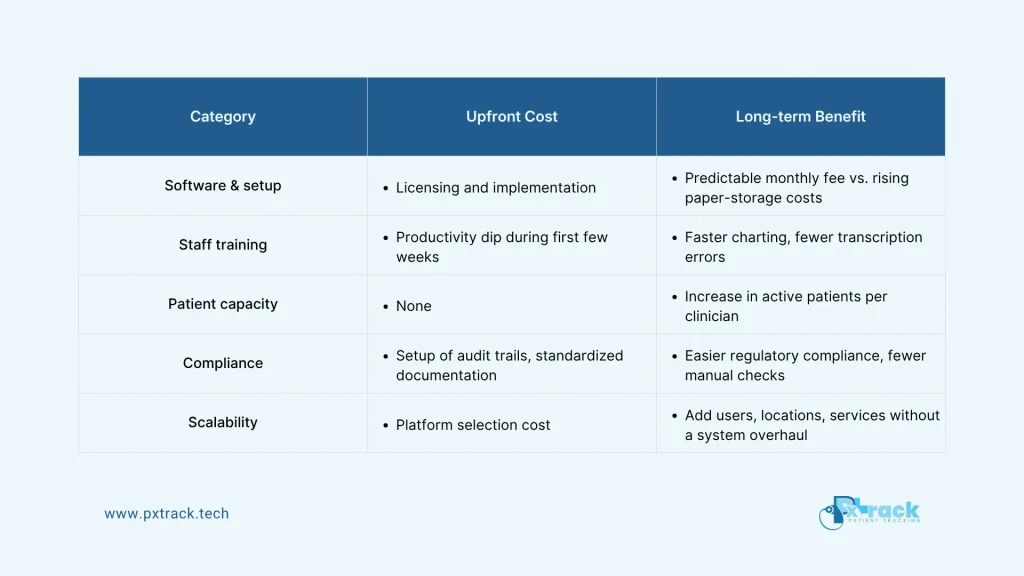
Initial costs usually include three things: the software license or subscription, implementation and data migration, and staff training. According to a study cited by Health Affairs, small medical practices in the United States spent about $44,000 per provider to start, plus around $8,500 per provider each year for ongoing costs.
In contrast, Philippine clinics usually don’t face such high costs. Cloud-based EMR systems remove the need for on-site servers and expensive IT equipment. So, smaller clinics can pay a fixed monthly fee instead of a large upfront payment.
Training takes some time because staff need to adjust to new workflows, and productivity might dip for a few weeks. This is a temporary challenge that leads to long-term benefits. Clinics that plan for the transition, instead of expecting instant results, adapt faster and see the benefits sooner.
When you view an EMR as a long-term investment, the math changes. Paper-based systems have hidden ongoing costs, like storage space and staff time spent filing and retrieving charts and records. These costs go up every year. A digital system, by contrast, replaces these rising expenses with a fixed, predictable cost.
The Long-Term Benefits of EMRs
You will see savings in three main areas: administration, productivity, and patient care.
Reduced administrative costs.
Paper charts require physical storage for paper, pens, and other supplies, printing, and staff time for filing and retrieval. Electronic medical records remove most of these tasks. Claims are processed faster because data entry happens once at the point of care, reducing manual data-entry errors.
Increased productivity through automation.
Once digitized, the system automatically handles appointment scheduling, prescription issuance, and lab result routing. Front-desk and clinical staff spend less time on repetitive tasks and more time with patients. A mixed-methods study of 17 primary care clinics found an average 27% increase in active patients per clinician after EMR implementation, alongside a 10% increase in the active-patient ratio for support staff.
Better patient care and compliance.
Digital records reduce transcription errors, automatically flag drug interactions, and give clinicians instant access to patient history during visits. This improves diagnostic accuracy and reduces repeat tests. Compliance is also easier, since audit trails, standardized documentation, and secure storage help clinics meet regulations without extra staff.
Growth of electronic medical records in the Philippines keeps accelerating as clinics move away from paper charts and toward systems built for local healthcare regulations and workflows. More clinics now search for EMR options that fit small-to-mid-size practices, not just hospital-scale systems built for other markets.

Measuring the Return on Investment
Return on investment for an EMR shows up in three measurable ways.
- Time savings. Appointment scheduling, digital intake forms, and easier charting save staff hours every week. Staff can spend that time on patient care instead of paperwork.
- Patient satisfaction and retention. Shorter wait times, fewer scheduling mistakes, and faster follow-up create a better patient experience. Patients who feel well cared for are more likely to come back and refer others.
- Scalable technology. A cloud-based EMR grows with your clinic. If you add a new provider, open a second location, or offer new services, you just adjust your current setup instead of overhauling the whole system.
Break-even timelines vary by practice size. Hospitals and larger systems take longer, often several years, but the cumulative savings scale with the size of the operation.
For clinics evaluating EMR providers in the Philippines, the decision comes down to fit: a system built for your practice’s size and workflow returns value faster than a system designed for a different market and scaled down.
Invest in Your Clinic’s Future
EMRs require an initial investment, but the financial and operational benefits build steadily after implementation. Lower administrative costs, higher staff productivity, and better patient outcomes compound over time. Clinics that hesitate because of cost alone miss the bigger picture: paper-based systems carry their own rising costs, just spread out and less visible.
With PxTrack, Philippine clinics get an EMR solution built for local practice. From patient charting to billing to compliance tracking, clinics see fewer administrative hours within the first few months of switching. Learn how PxTrack helps your clinic turn an upfront investment into lasting operational and financial gains.

Frequently Asked Questions
What is an electronic medical record (EMR)?
An electronic medical record is a digital version of a patient’s chart. It keeps the patient’s history, diagnoses, medications, and treatment plans in one searchable system instead of paper folders.
How much does an EMR cost for a clinic in the Philippines?
Cloud-based EMR platforms charge a monthly subscription instead of a large upfront license fee. Costs depend on clinic size, number of users, and which features you need, but cloud pricing keeps the barrier far lower than legacy on-premises systems.
How long does it take to see a return on an EMR investment?
Most clinics recover their EMR costs within 10 to 12 months through faster billing, fewer errors, and added patient capacity. Larger hospitals and health systems typically take longer, often several years, given the scale of their operations.